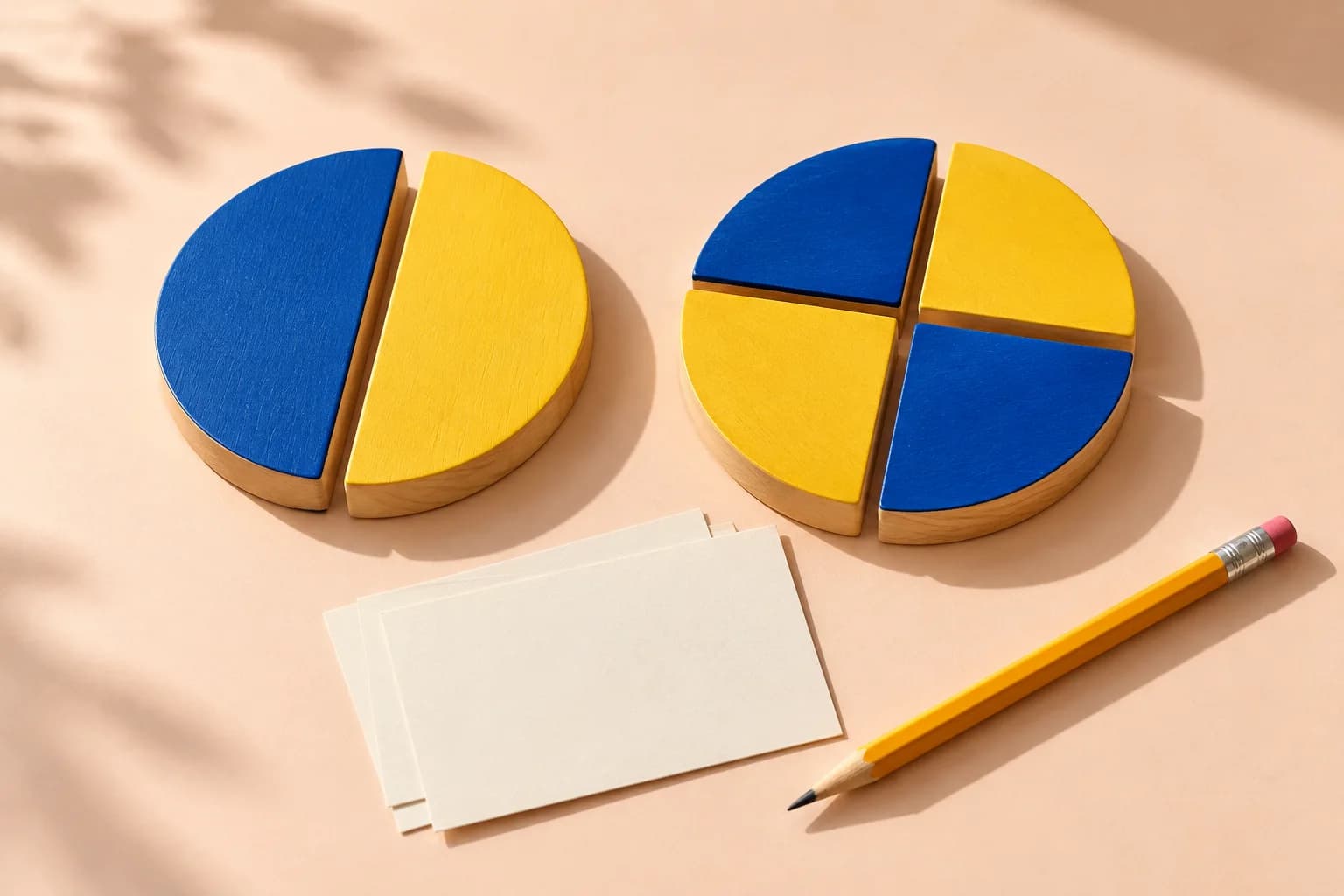
When a child says that one eighth is bigger than one quarter because eight is bigger than four, they are giving you useful information. They may be applying a whole-number idea to the denominator. Start there, with a picture and a question, rather than another page of rules. This guide offers four simple activities for exploring equal parts, fraction size, equivalence and number lines. The activities are home practice, not a diagnostic test or a fixed age-level standard. Use what your child shows you to choose a starting point and to have a more specific conversation with their school teacher or mathematics tutor.
Keep the whole the same, make equal parts and ask your child to explain what each number means. Use paper strips and a number line before relying on rules. The IES fractions practice guide recommends number lines as a central representation; the activities here turn that idea into parent-friendly practice.
Fractions support: an example from research
Number lines can help a child explain how large a fraction is. A reviewed fractions intervention shows what structured support looked like in one study.
students in the comparison
129 intervention and 130 comparison students, in grade 4.
What Works Clearinghouse · August 2013 — original sourceminutes per session
Small groups of three met three times weekly.
What Works Clearinghouse · August 2013 — original sourceweeks of teaching
The duration of the Fraction Challenge programme.
What Works Clearinghouse · August 2013 — original sourceAsk your child to place two fractions on the same number line and explain which is larger. If the explanation breaks down, share that exact example with the teacher before adding more calculation worksheets.
Context: WWC review, August 2013, of a US grade-4 intervention for students at risk of difficulty. The schedule describes that programme; it is not a universal prescription or a guarantee that twelve weeks will solve a child’s difficulties.
What should you ask before teaching another fraction rule?
Ask your child to show the fraction and explain the whole. “Draw one half” gives you more information than “Do you understand halves?” Watch whether the parts are equal, whether the child can identify the whole and whether their explanation matches the picture they have drawn.
Avoid correcting every line immediately. Ask, “How did you decide?” and give them time to point or draw. Their reasoning may reveal a specific missing connection even when the final answer is wrong. Keep one dated example to share with the teacher instead of describing the child as simply bad at fractions.
Choose familiar, low-pressure materials: equal paper strips, a pencil and a blank number line are enough. If drawing or cutting is difficult, prepare the materials yourself so that the activity still tests the mathematical idea. You are exploring understanding, not speed or neat handwriting.
Activity 1: does your child recognise equal parts?
Use two same-sized paper strips to compare an equal split with an unequal split. Fold one into two matching parts and divide the other unevenly. Ask which strip shows halves and why. The important idea is that a denominator describes equal parts of a chosen whole, not just any collection of pieces.
Next fold a fresh strip into four equal parts and shade one. Ask your child to name the fraction, identify the whole and explain what the four counts. If they call any shaded piece “one half,” return to matching parts before introducing more fraction symbols.
activity: equal or unequal?
- Prepare two identical strips; divide one equally and one unequally.
- Ask: which shows halves? Answer: the strip with two equal parts.
- Divide another identical strip into four equal parts and shade one.
- Ask: what does 1/4 mean? Answer: one of four equal parts of this whole.
- Change the shading to three parts. Answer: 3/4.
Activity 2: why can a larger denominator mean a smaller piece?
Compare unit fractions using the same whole. With identical strips, one divided into four equal parts and another into eight, one quarter is larger than one eighth. The activity below makes the comparison visible. Avoid comparing differently sized cakes or shapes, because that introduces a second changing quantity.
Ask your child to explain before introducing a rule: “We split the same strip into more equal pieces, so each piece is smaller.” Then ask whether the explanation still works for one third and one sixth. Keep the numerator at one while practising this particular idea.
Once that feels secure, explain the limit of the shortcut. A larger denominator alone does not decide every comparison when numerators also change. For instance, three quarters is larger than one half. A drawing or common number line helps your child compare the amounts rather than individual digits.
| question | Answer | What to ask next |
|---|---|---|
| Which is larger: 1/4 or 1/8? | 1/4 | Can you show the same whole split both ways? |
| Which is larger: 1/3 or 1/6? | 1/3 | What happened to the size of each piece? |
| Which is larger: 3/4 or 1/2? | 3/4 | Can you place both on the same strip? |
Activity 3: how does a number line make fractions clearer?
Place fractions as numbers between whole numbers rather than treating them only as shaded pieces. The IES fractions practice guide recommends number lines as a central teaching representation. Draw a line from 0 to 1, divide the interval into four equal lengths and ask your child to identify each position.
Count the spaces, not just the marks. Four equal intervals require the two endpoints and three internal marks. Ask where one quarter belongs, then three quarters. If your child places three quarters at the third mark without identifying zero, return to counting the lengths travelled from the starting point.
Extend the line to 2 when your child is ready. Five quarters lies one quarter beyond 1, so fractions do not have to be less than one. This extension helps keep the meaning connected: the denominator still describes the size of the fractional unit.
activity: walk along a number line
- Label the endpoints 0 and 1.
- Divide the interval into four equal spaces.
- Label positions 1/4, 2/4 and 3/4; the endpoint is 4/4 = 1.
- Ask where 1/2 belongs. Answer: the same position as 2/4.
- Extend to 2 and locate 5/4. Answer: one quarter after 1.
Activity 4: can different fractions name the same amount?
Show equivalence by keeping the shaded amount fixed while changing how it is partitioned. Shade one half of a strip, then divide the whole strip into four equal parts. The same shaded area now covers two quarters. Repeat with eight equal parts to see four eighths without changing the amount.
Ask, “What changed, and what stayed the same?” The number of named pieces changed; the total shaded length did not. This comparison separates the physical amount from the notation. It gives a reason for equivalent fractions before the child learns a written procedure for generating them.
Try the idea in reverse. If three of six equal parts are shaded, ask whether the shaded length reaches the halfway point. Accept a drawing or an explanation as evidence. A child who can recite “divide top and bottom” may still benefit from showing why the value stays unchanged.
activity: same shade, different partitions
- Shade half of one strip.
- Partition the whole into fourths: the shaded fraction is 2/4.
- Partition the whole into eighths: the shaded fraction is 4/8.
- Write 1/2 = 2/4 = 4/8.
- Fresh question: is 3/6 also one half? Yes: three of six equal parts reach the midpoint.
Turn what you observed into the next practice session
Choose the activity that exposed the first unclear idea and repeat it with a different drawing or material. If equal parts are still uncertain, adding fraction calculations may make the task harder to interpret. If comparisons are secure, move to equivalence or number-line positions and ask for an explanation.
Use these practice answers to check a fresh attempt: two shaded parts out of five equal parts is 2/5; one third is larger than one sixth of the same whole; three sixths equals one half; and seven quarters is one and three quarters. Ask for a picture alongside one answer.
Share a concrete observation with your child’s teacher: “They identify quarters on a strip but count marks incorrectly on a number line.” Ask which representation and notation the school uses. If you seek a mathematics tutor, look for someone who listens to the child’s explanation and adjusts the next task from that evidence.
Find Maths support for your child
Explore school Maths tutors and ask about your child’s age, curriculum and specific difficulty with fractions. Review online lesson arrangements if you prefer support from home.
Make it your own
Check things off as you go. Your selections last while this page is open.
A few more answers.
Should I start with fraction rules or pictures?
Begin with the representation that helps your child explain the idea. Paper strips and number lines can show equal parts, size and equivalence directly. Connect the picture to the written fraction rather than using either alone. Ask the school teacher how these ideas connect to the current classwork.
Does struggling with fractions mean my child has a learning difficulty?
These activities cannot establish that. They show specific ideas your child may need help with, such as equal parts or number-line intervals. If difficulties persist across schoolwork, discuss concrete examples with the teacher and ask what support or assessment process is appropriate. Avoid drawing a conclusion from one home activity.
How long should we practise fractions at home?
Choose a manageable session that lets your child explain their thinking without rushing. Stop when attention or frustration makes the activity unhelpful, and return later to one clear idea. There is no prescribed daily duration here; adapt practice to the child and coordinate with the teacher.
What should a fractions tutor do in the first lesson?
Ask the child to represent and explain fractions, then choose a task that addresses the earliest unclear idea. A useful lesson can connect a paper model, a number line and notation. Ask what your child completed independently and what short activity would reinforce that skill between lessons.
Sources & further reading
Explore the original resources for more detail. Practice examples in this guide are illustrative, not official examination questions.
Institute of Education Sciences: Developing Effective Fractions Instruction for Kindergarten Through 8th GradeYour questions. The right teacher.
Compare subjects, experience and prices. Find a tutor who fits your course, level and learning goal.
Find school Maths tutors